

Top Trends for 2026
Recent studies underscore the growing strategic importance of artificial intelligence in marketing: Companies can realize the greatest revenue potential through the use of AI, particularly in marketing and sales, where AI acts as a key growth driver. (McKinsey, 2025) In practice, AI is primarily used for the intelligent collection and processing of information, for example, via dialogue-based interfaces. From brainstorming to the structured preparation of knowledge for sound marketing strategies: the applications of AI in marketing are diverse:
- Content strategy and editorial planning with AI
- Development of market launch strategies
- Competition and market analyses
- Brand positioning and sharpening
- Target group analysis and personalized approach
AI marketing will continue to evolve in 2026 from an experimental use case to scalable, value-adding applications, and forms the basis for the key AI marketing trends in 2026:
Autonomous AI Agents
In 2026, agentic AI in particular will drive marketing and customer data analysis forward: AI agents are already taking on autonomous roles in marketing by performing complex tasks such as data analysis, personalization, and campaign optimization independently without much human intervention. This offers great potential for increasing business efficiency. They act as intelligent assistants within the company, and their integration brings the following advantages, among others:
- data-based real-time decisions through more comprehensive data sources (e.g., purchase history and preferences),
- continuous brand monitoring and optimization for a higher ROI,
- cost savings in content production, and
- potential budget increases in marketing.
The Model Context Protocol (MCP), which was introduced as a standard by Anthropic at the end of 2024, plays an important role in this. It seamlessly connects agents and users with systems such as consumer insights databases, CRMs, and AI tools such as ChatGPT or Claude. Read more about this in our article “MCP Server - The New Interface Between AI and Enterprise Systems”.
Agents enable hyper-personalization by delegating purchasing decisions and increasing brand visibility via Generative Engine Optimization (GEO). Instead of open web data, they provide dynamic, customer-specific insights. As a result, lead generation can also take place automatically. Companies were already showing great interest in AI agents in 2025: 62% of respondents stated that their companies were at least experimenting with AI agents. (McKinsey, 2025) AI agents are a decisive factor for a company's future marketing success because, compared to other AI tools, they are characterized by significantly greater autonomy and their ability to learn from experience and continuously adapt independently.
Customer Insights
The use of AI in marketing enables companies to understand contexts more holistically and make more informed decisions based on customer insights. These enable companies to understand customer behavior much more quickly and in greater detail than with traditional analysis methods, resulting in higher satisfaction. Insights are gained into
- customer preferences,
- opinions,
- needs, and
- behaviors
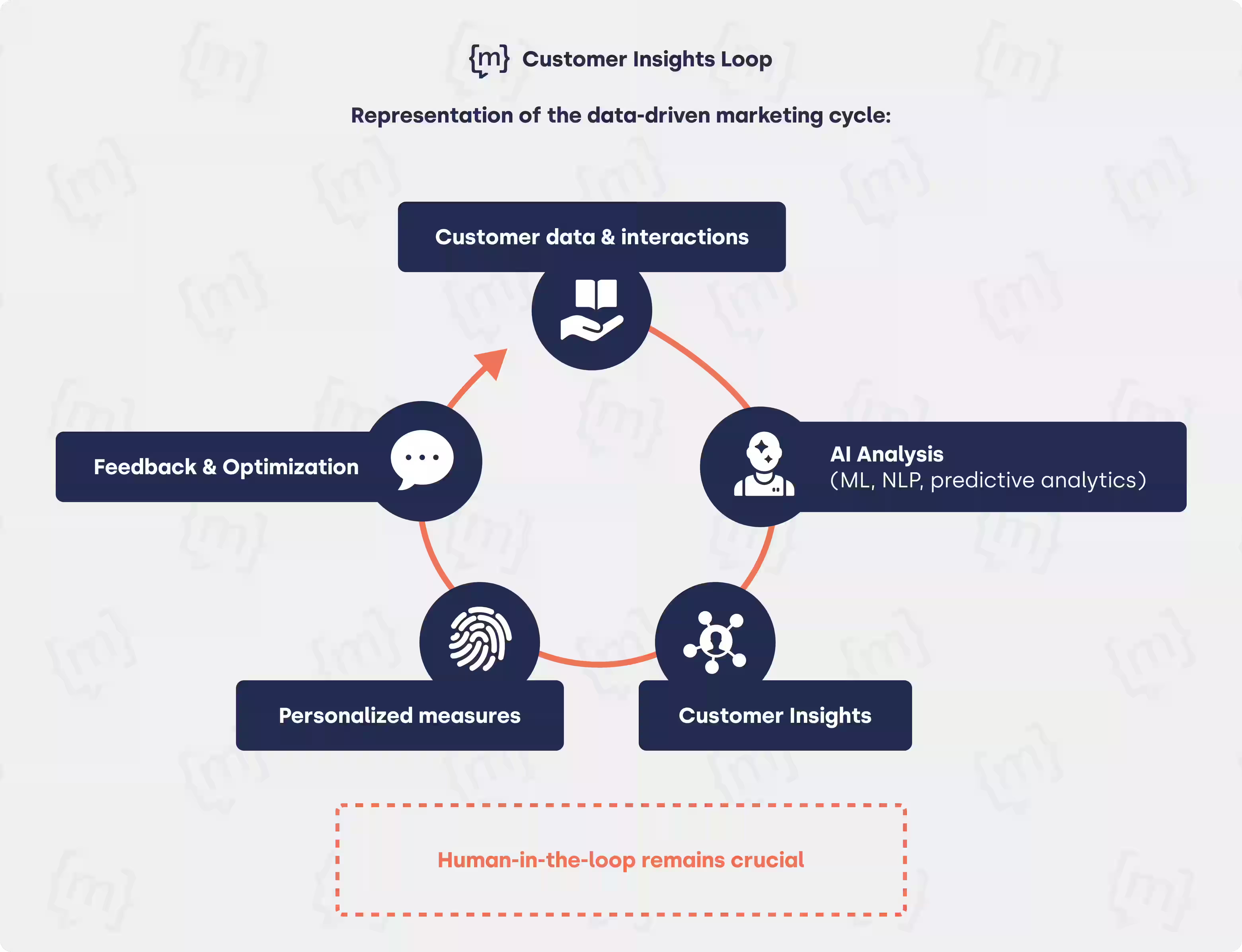
among other things, and then translated into consumer-oriented decisions. The use of machine learning, natural language processing, and predictive analytics enables the processing and evaluation of large amounts of structured and unstructured data, from which conclusions about customer needs and marketing strategy can then be drawn. Brands can use these insights to make consumer-oriented decisions. It is crucial to use AI on a strong data foundation, because the insights are only as good as the data on which they are based. Despite the advantages of AI in speed and pattern recognition, it cannot completely replace the context and critical interpretation of human actors. In addition, biases in training data continue to pose a challenge.
What is GEO? Generative Engine Optimization explained
GEO, short for “Generative Engine Optimization,” refers to the alignment of content with generative search engines such as ChatGPT, Perplexity, or Google AI Overviews in AI-supported marketing. Traditional search engine optimization (SEO) involved evaluating keywords and increasing visibility by using appropriate words, whereas GEO aims to get AI systems (large language models, LLMs) to prioritize brand content as trustworthy sources and cite it in synthesized responses. Marketing professionals need to adapt their SEO strategies to optimize content for conversational search queries rather than just keywords:
.avif)
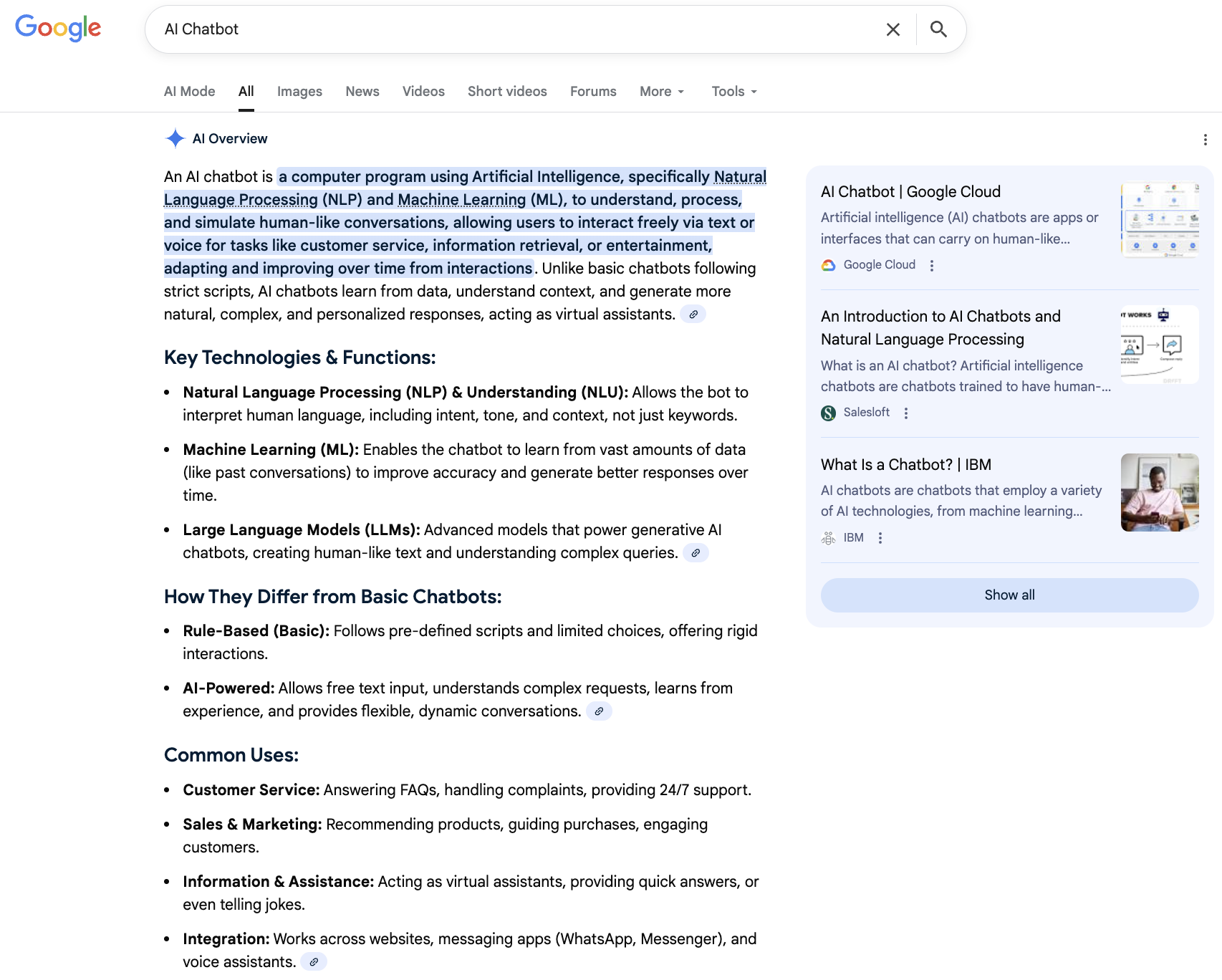
GEO is an advanced strategy for making content visible to generative engines, including Google AIO. Here is an example of a Google search for “AI chatbot”: The result is the AIO, with various source references to websites for explanation.
The GEO forecast for 2026 shows four key development trends in the AI-supported search and content environment:
- From ranking to citation: Content must be cited and recommended by AI systems, not just found
- Trust and authority: Credible, technically sound content is gaining importance over generic AI content, e.g., through author attribution and references
- AI-readable content: Clearly structured, logically organized content is crucial for use by LLMs.
- Multimodal search: Relevance goes beyond pure text; optimization for visual, audio, and conversational formats is crucial.
Content must be positioned as a trustworthy source of knowledge to be actively picked up and cited by AI systems. This requires a focus on consistent brand messaging and verifiable expertise across all channels and increases the demands on companies to prepare data cleanly.
AI-supported content generation
AI-based content creation (AI content generation) is already one of the most frequently used and effective applications of artificial intelligence in marketing. Marketers rely on predictive and generative AI to boost creativity, generate content, and achieve greater output with fewer resources. (Salesforce, 2024) The following statistics show that content creation with AI is becoming increasingly important and will continue to gain ground as a trend in 2026:

Generative AI is not used as a replacement, but as a creative amplifier: for developing ideas, scaling content, and making more efficient use of limited resources. A key advantage is the reduction of cognitive load. Due to the constant flow of emails, social media posts, newsletters, and push notifications, attention is becoming a rare resource. Effective AI implementations do not aim for the maximum amount of content, but rather for relevance: AI can be used to prioritize content and focus on the essentials. User behavior is thus increasingly shifting from passive consumption to conscious selection and filtering. For companies, this means that AI recognition tools are needed to verify the authenticity of content shared across all communication channels. With the increased proliferation of AI-generated content, greater transparency and trust mechanisms are required. Authenticity and brand integrity must be ensured across all communication channels.
Hyper-personalization and emotional marketing
In marketing, hyper-personalization is increasingly becoming a crucial aspect of setting oneself apart from others. According to McKinsey, 71% of consumers now expect tailored experiences, and 76% express frustration when these expectations are not met. (McKinsey, 2025) This makes personalization a minimum requirement that directly affects customer perception, loyalty, and purchasing decisions.
More and more companies are actively involving their communities in decision-making processes to help shape product development and marketing strategies. The technological basis of this new infrastructure is AI-supported systems: they examine large amounts of unstructured data and segment target groups based on this. This enables companies to respond dynamically to user moods and needs. In combination with other AI applications (e.g., predictive analytics or generative AI), emotional AI can lead to much greater efficiency and impact in marketing campaigns.
In particular, the ability of emotional AI to design or select ads that “resonate” with the mood of the target group generates higher interaction rates. The trend away from purely data- and behavior-based approaches toward emotion-based approaches is a decisive competitive advantage for companies. At the same time, the risks of emotional AI must be taken into account, e.g., the collection and use of emotional data in the context of data protection. Marketing managers must establish clear ethical guidelines and ensure transparent communication with customers.
Predictive Analytics
Predictive analytics is an important component of data-driven AI marketing strategies. Essentially, it involves evaluating historical and current data in such a way that AI models can predict needs, behavior patterns, and movements. For marketers, this shifts the focus from reactive analysis to proactive management of campaigns and budgets. A typical use case is predicting customer behavior throughout the entire customer journey.
AI-supported models provide early information about the likelihood of a purchase, churn risks, or reactions to specific content and channels. On this basis, not only are individualized measures possible, but also their optimal timing and contextual delivery.
In addition, predictive analytics is becoming increasingly important for strategic marketing decisions. Predictions about demand trends or campaign success allow for better-informed resource allocation and reduce planning uncertainty. In combination with automation and personalization systems, predictive analytics is becoming part of a forward-looking, AI-supported marketing ecosystem.
Chatbots for high conversion rates
Chatbots are evolving from pure service tools to active conversion drivers in marketing and sales. With modern, AI-powered chatbots, companies are able to accompany users throughout the entire decision-making process, answer questions in real time, reduce uncertainty, and guide users to the next logical step. The combination of context and personalization is a key success factor for high conversion rates. AI chatbots can analyze user behavior, identify interests, and learn from previous interactions to dynamically customize responses, product recommendations, or calls to action. Generic dialogues are replaced by situational conversations that are tailored to the user and minimize conversation dropouts – even in complex purchasing processes or those requiring explanation. The comprehensive integration of the chatbot into the marketing and sales infrastructure is crucial. This includes the integration of
- CRM systems
- product databases
- analytics tools
- marketing automation platforms
- e-commerce and shop systems
- support and ticketing systems
so that relevant data can be collected in a structured manner and seamlessly transferred to human teams. By 2026, chatbots will be a central component of data-driven conversion strategies in which automation, user experience, and measurable business success are closely linked.
Why AI marketing is essential
Companies no longer use AI in isolation, but integrate it into their core processes in order to operate faster and more scalably. Whether in sales, HR, operations, or marketing, the strategic use of AI is crucial to remaining competitive. AI marketing represents an interface that enables data-driven decisions across all areas. AI can translate large amounts of data into actionable insights, enabling personalized experiences throughout the customer journey. This enables companies to have
- more efficient workflows,
- an improved ROI, and
- scalable processes.
The greatest strength of AI marketing lies in the symbiosis of human control and machine learning. AI is used for analysis, forecasting, and automation. Ultimately, humans set the strategic direction and ensure that AI is used transparently and responsibly.

What companies need to consider now
According to a McKinsey report, 78% of companies already use AI in at least one area of their business, but only 1% consider their implementation to be mature. (McKinsey, 2025) This represents a huge opportunity: strategic AI integration across the entire ecosystem must be implemented urgently in order to secure competitive advantages. Robust governance frameworks and ethical standards are becoming key differentiators: AI-native companies generate significant cost advantages through optimized processes, while TRiSM (Trust, Risk and Security Management) is becoming mandatory to ensure data protection and compliance. With the consumer at the center, it is important to note that increasingly authentic human experiences are being demanded amid AI-dominated interactions. This is where differentiation comes in through emotional closeness and storytelling. Companies should invest heavily in their own channels, such as email lists, communities, and proprietary apps. These protect against platform changes in social media or AI engines, minimize single-channel risks, and build stable stakeholder relationships – essential for sustainable marketing ROI in 2026.
Conclusion: The transformation of marketing with AI
Artificial intelligence is changing marketing and forcing companies to rethink the way they address customers: more personal, more efficient, and more data-driven at the same time. AI improves processes along the entire marketing chain and helps with the targeted allocation of resources to promote sales growth. At the same time, the role of marketers is shifting away from operational tasks toward strategic thinking, creative storytelling, and building genuine, trusting customer experiences. However, successful AI marketing is not based solely on technology. Regulations such as the EU AI Act are making legally compliant action an increasingly important competitive factor. Clear structures for governance and responsibilities are becoming more important than ever.
Data must be used in an integrated manner within the company and must not be stored in silos. Ultimately, it's all about striking the right balance – powerful AI systems and strategic human control for evaluating qualitative data.
Companies that succeed in achieving this mix transform vast amounts of consumer data into comprehensive, actionable insights about their customers, thereby securing a sustainable competitive advantage in the market.
[[CTA headline="Achieve measurable success with moinAI AI Marketing!" subline="moinAI combines AI chatbots, AI agents and data-driven automation into a single platform that boosts conversions." button="Try it now!"]]


